Jump to:
- Quick answer: tree removal permits in Brisbane
- Why Council protects trees in the first place
- What counts as protected vegetation
- When you don’t need a permit
- The 3 permit types
- How to apply
- What happens if you skip the permit
- Dead or dangerous trees
- Bottom line: tree removal permits in Brisbane
- FAQ: tree removal permits in Brisbane
Quick answer: tree removal permits in Brisbane
In Brisbane, you often need Council permission to remove a tree, even on your own land. Ownership alone does not exempt you.
The main exception most homeowners use is a tree that is dead, dying, or dangerous. Everything else depends on whether the tree counts as “protected” under Council’s rules.
Permits are free. Fines are not. Check before you cut.
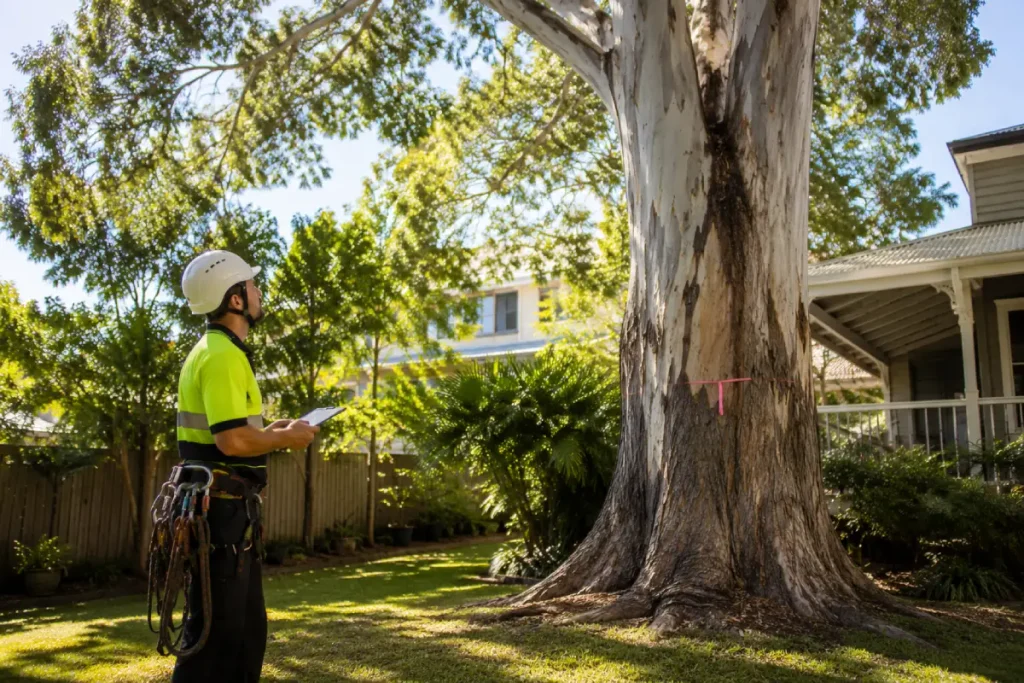
Why Council protect trees in the first place
Brisbane set a target of 50% shade canopy across the city by 2031. An internal council review found actual coverage sitting at just 32% as of 2019, down from 35% a decade earlier, even with an average of 5,243 new trees planted in streets and parks each year.
That gap is the backdrop to every permit rule in this guide. Council isn’t trying to make removals difficult for the sake of it. Each mature tree removed without replacement works against a target the city is already behind on.
This doesn’t change what you’re allowed to do with a dead or dangerous tree on your own property. It does explain why the rules apply even inside your fence line, and why “it’s my land” isn’t the deciding factor Council uses.
What counts as protected vegetation
Brisbane City Council sorts protected vegetation into four groups:
- Council vegetation – anything on Council-owned land, including street trees and park trees
- Waterway and wetland vegetation – plants in or around natural or built waterways and wetlands
- Significant urban vegetation – native or exotic trees on private land that Council sees as mature or prominent
- Significant native vegetation – native plants, from ground covers to large trees
Council has not published an exact trunk width or height that triggers protection. If you can’t tell which group your tree fits, ask Council directly or get a certified arborist to check before you plan any work.
When you don’t need a permit
An exemption exists, but it’s smaller than most people think. It only covers certain work on your own property. It does not cover:
- Pruning or removing vegetation on Council land, even next to your fence
- Any work on a property you don’t own
- Pruning, removing, or building near the roots of a significant landscape tree
- Construction near or under a protected tree’s canopy
- Trees protected by other rules, such as heritage-listed trees
If any of these apply, you need a permit no matter how big or small the tree is.
The 3 permit types
Council offers three permits, and each one covers different work.
| Permit type | How long it lasts | What it covers | Typical use case |
| Short-term work permit | One-off job | A single removal or pruning task | Most homeowner tree removals |
| Long-term work permit | Up to 10 years | Ongoing or repeated work on the same vegetation | Larger properties, regular maintenance |
| Street tree permit | Per request | Minor pruning of Council-owned street trees only | Trimming a footpath tree blocking your driveway |
How to apply
Protected vegetation permits are free to apply for. The real cost is in the paperwork, not the fee.
Council usually asks for photos of the tree, a site map, and, for higher-risk or significant vegetation, a written arborist report.
If someone else co-owns the land, you also need their written consent before Council will process your application.
What happens if you skip the permit
There’s no single fixed fine. Council can respond with anything from a warning notice to prosecution, depending on how serious the breach is.
Size doesn’t matter here. If the vegetation was protected and you had no permit, the removal was against the rules, and Council decides how to respond.
A short-term permit costs nothing to apply for. It almost always takes less time than dealing with a warning notice after the fact.
Dead or dangerous trees
The exemption most homeowners actually rely on is for vegetation that has died, is dying, or is unsafe. Council’s guidance and independent arborists both treat this as the main practical exception to the permit rule.
Even so, get it documented before you remove it, not after. A written report from a qualified arborist confirming the tree’s condition protects you if Council ever questions the removal.
Storm-damaged trees work the same way. If a tree splits or leans badly after bad weather, have an arborist record its condition as soon as you safely can.
Bottom line: tree removal permits in Brisbane
Whether you need a permit depends on what the tree is, not on where your fence line sits. Significant, native, waterway-side, or Council-controlled trees need approval. The property exemption covers most other cases, but not root zones of significant trees, construction work, or land you don’t own.
If the tree is dead, dying, or dangerous, that’s the exemption most people end up using, and it holds up best with an arborist’s report in hand.
If you’re not sure whether your tree is protected, Tree Lopping Brisbane’s arborists can check it and handle the permit paperwork before any work starts, or contact the team directly with any questions first. Once that’s sorted.
See our guide on what tree removal actually costs in Brisbane to budget for the job itself.
FAQ: tree removal permits in Brisbane
Sometimes. Ownership doesn’t automatically exempt you. It depends on whether the tree falls into one of Council’s four protected categories.
Dead, dying, or dangerous trees are the main exemption homeowners rely on, but get a written arborist assessment first so you have proof of the tree’s condition.
Yes. The council doesn’t charge an application fee. The effort is in gathering photos, a site map, and sometimes an arborist report.
Council can respond with anything from a warning notice through to prosecution, depending on how serious the breach is.
No. Council’s exemption list also covers pruning and root-zone work near significant landscape trees, so pruning can need a permit too.
Brisbane is well short of its own 50% shade canopy target for 2031, sitting at 32% coverage as of the last review. Permits are one way the Council tracks and slows the loss of mature trees city-wide.